Iluma

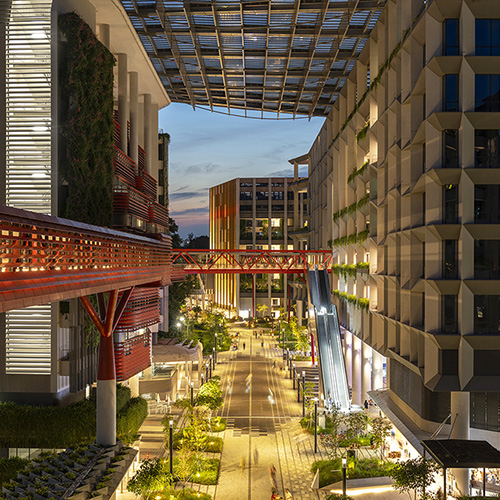
Iluma is an entertainment and retail development, located at the famous Bugis Street area in Singapore, now a designated arts, education and entertainment district.

The design contrasts a rectilinear block against a curvaceous sculpted form. The rectilinear element accommodates large, regular components of the car park, retail anchor tenants, cinema and performance spaces, while the curved form accommodates smaller retail and entertainment activities along meandering paths.

The dialogue between the two elements is heightened by the architectural treatment, with vibrant hot colours animating the rectilinear block and monochrome shades of grey and white cladding the curvilinear block. Overlooking, overlapping and directing views up, down and across, are strategies throughout the building, inside and outside, to enhance vibrancy, people-watching and excitement.

The Reserve Residences

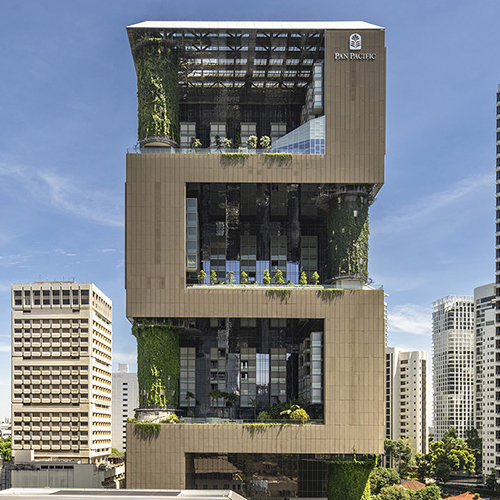
The Reserve Residences is a nature-inspired, nature-positive development and the new southern gateway to the Bukit Timah Nature Reserve, Singapore’s largest surviving primary rainforest. It integrates residences, serviced residences, retail and community spaces with a bus interchange and is directly connected underground to the Beauty World MRT station.

The design stacks various uses vertically, creating multiple ground levels with public and resident amenities, gardens and facilities. This strategy multiplies community spaces throughout the development, providing high-density, high-amenity live-work-play-learn spaces embedded in lush sky greenery.

The expansive and diverse landscaping connects to the greenery of the surrounding nature reserves and extends the natural forest into the urban fabric. It enlarges the nature reserve’s ecological capacity and strengthens the region’s biodiversity.

The facade, reminiscent of the Bukit Timah Nature Reserve’s picturesque re-wilded quarries, blends stone walls with hanging gardens around the development’s perimeter, evoking a sense of place while shading the building interiors. Passive strategies (natural ventilation, daylighting, sunshading, breezeways and landscaping) in combination with active strategies (hybrid cooling, HVLS fans) create a comfortable environment and reduce energy consumption.

The residences are tranquil havens clustered to form ‘Sky Villages’ amidst the highrise greenery. These elevated neighbourhoods encourage residents to get to know each other and create their own close-knit micro-communities within the development.

Self-Sufficient City

Self-Sufficient City is a design concept for a new town in Indonesia that is regenerative, high density, high amenity, self-sufficient in food, energy and water, car-free and has high biodiversity and ecosystem services.

The brief was to house 210,000 people on a 730 Ha site that is overgrown with secondary rainforest and constrained by a 60m building height control limit. A 3-Dimensional master planning approach was adopted to create a tropical ‘eco-town-in-a-forest’, retaining over half of the existing green landscape.

Four distinct layers run through the town, integrating regenerative systems into the urban form:

  • A Transportation and Services Layer that segregates pedestrians from vehicles. Town-wide infrastructure includes pneumatic waste and recycling collection system, district cooling for the industrial estate and combined underground services tunnels under roads;
  • A Parkland Layer beneath blocks that comprises Tropical Community Spaces for public functions and social interaction. The Parkland Layer prioritizes people with well-connected mobility paths and trams, and a safe car-free environment within public gardens. A diverse topographic landscape, with terraced knolls and elevated decks, overlooks forest glades and the waterways of the town’s reservoir. Pavilions and venues for meetings, parties, and community events are located on the reservoir waterfront, along with boutique-style shops and cafés;
  • A Residential and Workplace Layer organized into a series of Breezeway Courtyards that form an Inverted Skyline;
  • A Rooftop Canopy Layer that is both protective and productive, providing shade and shelter as well as solar energy and food harvested from Sky Field crops. More than 3km2 of photovoltaic panels installed on the Rooftop Canopy Layer generate a 40MW system that can support the fully net zero energy town. With the Inverted Skyline typology, all building rooftops are capped at the same height, which ensures that no energy losses occur from over-shadowing.

Beachfront Destination

The development is a tropical high-rise 3-in-1 beachfront destination comprising of a diverse mix of retail, residences and hotels topped with sky gardens, recreational amenities, demonstrating that high density can be high amenity.

Flanked by a popular beach to the west and the bustling city to the east, the contoured podium is sculpted to form a porous, fully public and pedestrianised retail plaza to seamlessly connect the beach to the city. The tropical beach experience is brought into and up the building – from the breezy event plaza to the stunning infinity pools set in tropical sky gardens.

The project adopts robust passive design strategies such as naturally lit and ventilated lobbies, pre-function areas and access corridors such that these public areas become functional, comfortable, tropical spaces with greenery, natural light and fresh air instead of enclosed, internalised air-conditioned spaces.

The configuration and orientation of the hotel and residential towers are designed to maximize the panoramic sea views for all units with balconies inspired by the organic shapes and colours of corals, alluding to a thriving ecosystem of variegated corals.

Agri-food production in Singapore

More information coming soon.

Carnival of Life

The project showcases the Singapore story, reinforcing core values and cementing

Singapore as a beacon of transformative thinking. We imagine an ultra-Singapore that we know but can’t yet find – an experience that is super lush, tropical and shady, a blend of eating, shopping, and people-watching.

The Carnival of Life takes everything we love about Singapore and catapults it into the most desirable future to become a showcase to the world. It addresses how might we live better, longer and with lives filled with joy and wonder. The vision for the Carnival of Life creates a stage to answer these questions, while creating the most immersive and innovative attractions in Asia.

The Carnival of Life is tied together via a whimsical ribbon. This iconic promenade is a stage for community life and connects visitors to a sequence of attractions celebrating the best of Singapore, centred on food, water, and health. It is a new free lifestyle destination for Singaporeans, promoting community and wellbeing

Diverse yet thematically linked attractions are spread along The Ribbon, a linear park comprised of delightful public spaces.

We envision the Carnival of Life to be Singapore’s 4th Major Public Garden, creating a Regional Public Space for the North. Using Wonder, Multi-Sensory Exploration and Education, the Carnival of Life will be the most immersive and innovative masterplan of attractions in Asia, piloting and engaging global audiences in new regenerative ways of living.

Green Habitat Karachi

More information coming soon.

Future City Xicen

Xicen Country City masterplan presents a holistic solution for the upcoming development of a 7.1 km2 site on the southern bank of the Dianshan Lake, which is located in the Yangtze Delta area in close proximity to Shanghai, Hangzhou and Suzhou. The site has rich water network that takes up about one thirds of the total site area. This masterplan is a prototype for more livable and sustainable developments of the future that brings all the amenities and convenience typically found in existing metropoles in a location embraced by nature.

The proposed masterplan adopts a 50/50 City approach, allocating most of the urban development to the northern half of the site while preserving nature and indigenous culture in the southern half. In the urban half, surface vehicular roads are reduced to a minimum and the land is divided into a series of thematic islands in order to tap into the rich green and blue resources of the site, while celebrating the unique waterfront lifestyle of the Xicen region.

The Urban Core Islands have the highest density and programmatic mix with a district transport hub, civic/commercial plaza and arts/cultural center seamlessly connected to the metro and high-speed railway stations. The R&D Islands integrate garden offices, R&D facilities, and business incubators with residences to suit the future need of high-tech industries. The Residential Islands face the water and benefit from a natural biophilic environment. A series of Rewilding Islands are embedded into the urban spaces, allowing regenerative nature to render bioremediation and ecological services to the built environment.

The nature half is grouped into four zones: Eco-Tourism Zone, High-Tech High Intensity Farming Zone, Campus Village Zone and SME Creative Clusters Zone. By enhancing agricultural and energy production as well as inserting anchor industries and schools, Xicen Country City will become a selfsufficient and resilient urban typology wellequipped for all the future challenges and opportunities.

Future City Maqiao

Maqiao Future City is located in the southwest of Shanghai, 35 km away from the city center. It is the 20-hectare core development area of the future Shanghai AI Innovation Zone. The vision of this masterplan is to create an integrated new town as the driving engine for the larger region and a human-centric destination place that celebrates future live, learn, work and play. It will also be a demonstration project that aims to achieve carbon neutrality in phases.

The masterplan adopts the 50/50 City strategy, preserving half of the land for restorative and regenerative green and blue spaces and the other half for high-density high-amenity urban development, allowing a balanced synergy to grow between nature and the built environment. Programmatically it follows the same concept, proposing half of the development as residential spaces and the other half as a mix of R&D offices, commercial and community spaces.

Maqiao Future City consists of eight interconnected clusters, the Urban Core being the most dense and mixed-use. It integrates metro station, district transport hub, retail shops, urban plaza, and landmark buildings to create a welcoming gateway to the city and a vibrant civic center that forges a strong community spirit and sense of place.

Radiating out from the Urban Core are three Garden Office clusters with SOHO apartment blocks and various embedded business incubators that act as a physical and functional bridge between the urban spaces and the spaces left to nature. The waterfront residential clusters offer community spaces such as sports halls, schools, or healthcare centres.

A 3-dimensional planning strategy is introduced to bring things together. Vehicular roads, district infrastructures and services are buried underground, leaving the ground level fully pedestrianized and maximized for nature. Multiple landscaped ground levels are created above to facilitate stronger connection between clusters and further enhance the ecological system.

Wilkie Edge

This project is in Bras Basah – Bugis district, an arts, education and nightlife zone. New zoning allows media facades and advertisements, which are not allowed in the rest of the central district: the intent being to create night time buzz.


The area has a diverse mix of buildings of different eras and scales. To the north-east is a conservation area of 3 storey shophouses. Mt Sophia, to the north, is in transition from old houses and institutional buildings to dense 12 storey apartments. To the west are large podium and tower buildings from the 1980s. On the east are public housing slab blocks in bright colours. Urbanistically, we wanted to address the disjunctions in scale, and contribute to the buzz of the neighbourhood.